Can a surgeon read an MRI finding without looking away?
Alice Saito, John Yechan Jo and a teammate designed AI smart glasses that detect brain tumors on MRI images with YOLOv11 and describe them in plain language through the Grok 3 API. The detection pipeline was tested on a smartphone, not yet on glasses. Their hardware design came to 68 g, 9.6 W and up to 4.7 hours of use.
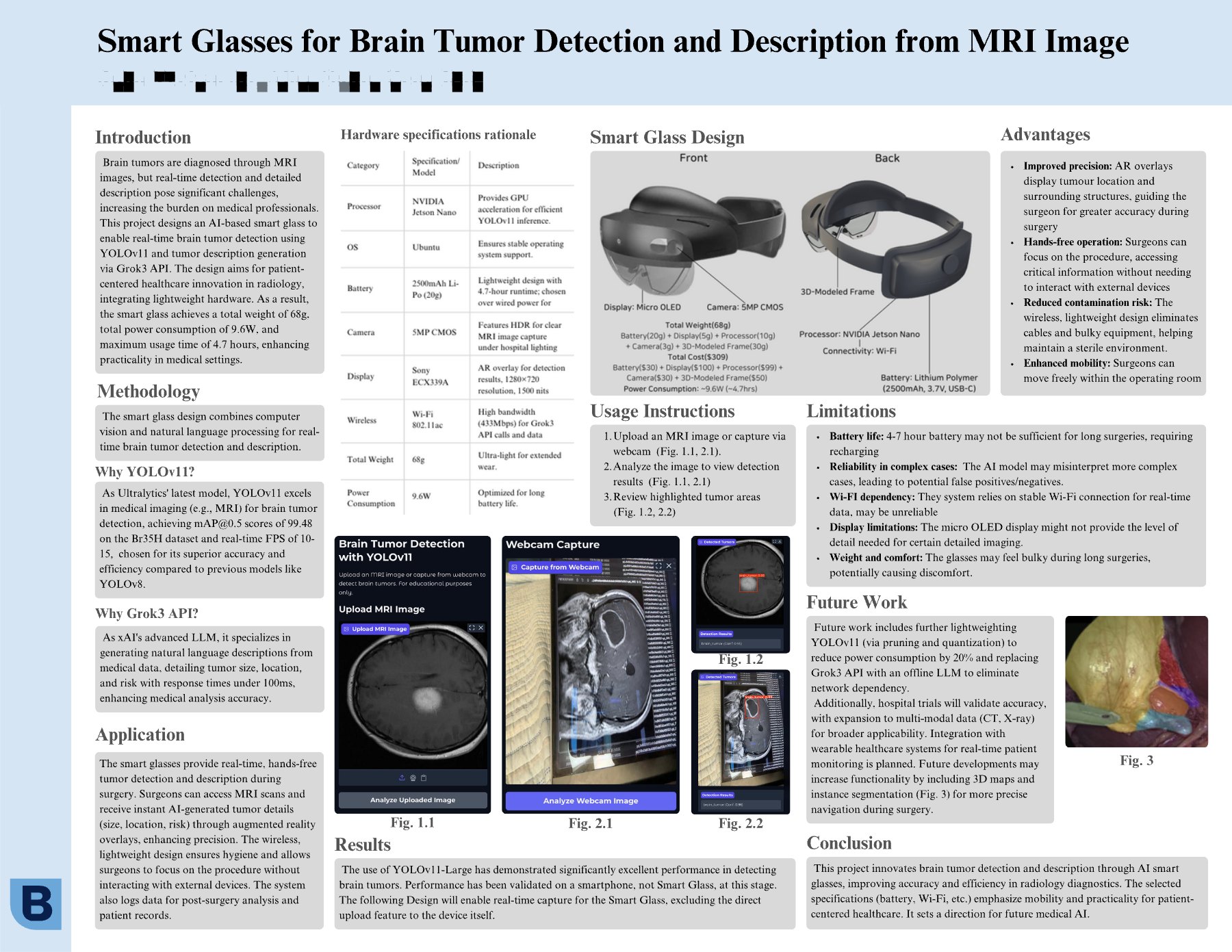
Reading MRI images during surgery means looking away from the patient. This team designed AI smart glasses that show tumor findings in the wearer's view. A YOLOv11 model trained on the Br35H brain MRI dataset detects tumor regions, and the Grok 3 API turns the detection into a short description of size, location and relative risk. The team chose hardware components from real AR-glass specifications, arriving at a design of 68 g, 9.6 W and a maximum of 4.7 hours of use. The full pipeline (upload or capture an MRI, detect, highlight, describe) was validated on a smartphone, not on the glasses themselves. The poster lists open problems: battery life for long surgeries, dependence on Wi-Fi, display detail, comfort, and the risk of false positives or negatives in complex cases.
Keywords · smart glasses · YOLOv11 · brain tumor detection · MRI · LLM descriptions · wearable AI
Who did this work


Students named here agreed to be featured. 1 other team member is not named.
1The problem with looking away
Brain tumors are diagnosed and planned from MRI images, but checking those images during a procedure means turning to a screen.
The team asked whether a lightweight wearable could put the finding, and a plain-language description of it, directly in the surgeon's view.
2Detection, description, and a hardware budget
- Trained detection. Trained YOLOv11 on the Br35H brain MRI dataset to find tumor regions.
- Added descriptions. Sent detections to the Grok 3 API to generate short descriptions of size, location and relative risk.
- Built the flow. Upload or capture an MRI, analyze it, highlight tumor areas, show the description.
- Designed the hardware. Chose battery, display, Wi-Fi and processing components from real AR-glass specifications and totaled weight, power and use time.
3A working pipeline and a realistic hardware budget
| Item | Result |
|---|---|
| Detection and description pipeline | Working, validated on a smartphone |
| Total weight (design) | 68 g |
| Total power (design) | 9.6 W |
| Maximum use time (design) | 4.7 hours |
| Running on the glasses | Not yet; real-time capture on glasses is the next design step |
4The poster
The team's final poster. The name of the teammate who is not featured is blurred.
5What this does not show
- The system was not run on smart-glasses hardware.
- Detection accuracy was not benchmarked against alternative models in the poster.
- Descriptions rely on an external API and a network connection.
- Clinical use would need hospital trials, which are listed as future work.
6What this work shows
Researcher in AI Hardware and Embedded Systems
Did research at MIT on integrated photonics and AI-driven health sensing. 14+ journal papers, 5 patents. Builds wearable AI devices in industry.
The team built the pipeline and the design. The Project Lead guided the work and reviewed it.
Wearable AI · Medical devices · Edge computing
A design grounded in real component specifications shows product and hardware judgment.
7What the Project Lead observed
The Project Lead wrote feedback on the project at the end of the program.
Written feedback only
This cohort ran before the four-level capability rating was recorded, so this page shows the Project Lead's written feedback without a level.
- Strengths
- Strong technical execution and clear communication throughout the project.
- System awareness
- Grounded the design in realistic AR-glass specifications, showing awareness of feasibility and market fit.
- Presentation
- A well-structured final presentation that covered the full process from model design to system integration.
Where the Project Lead pushed further. Benchmark YOLOv11 quantitatively against alternative models, and work through hardware constraints and usability in more detail on the way to truly hands-free use.
Source: the Project Lead's and Academic Team's written feedback, 2025–26.
References
- Ultralytics (2024). YOLO11 documentation.
- Br35H: Brain Tumor Detection 2020 dataset (public MRI dataset).
Join the AI in Hardware program
Work with an AI hardware researcher on wearable AI and leave with a design you can defend.