Can you make cells younger without making them unsafe? Three scores instead of one.
A team of six students tested partial reprogramming, a way to make aged cells look younger, using single-cell data from mice. They scored youth, cell identity and risk separately. In the treatment they tested, none of four comparisons landed in the hoped-for safe zone, and they reported why.
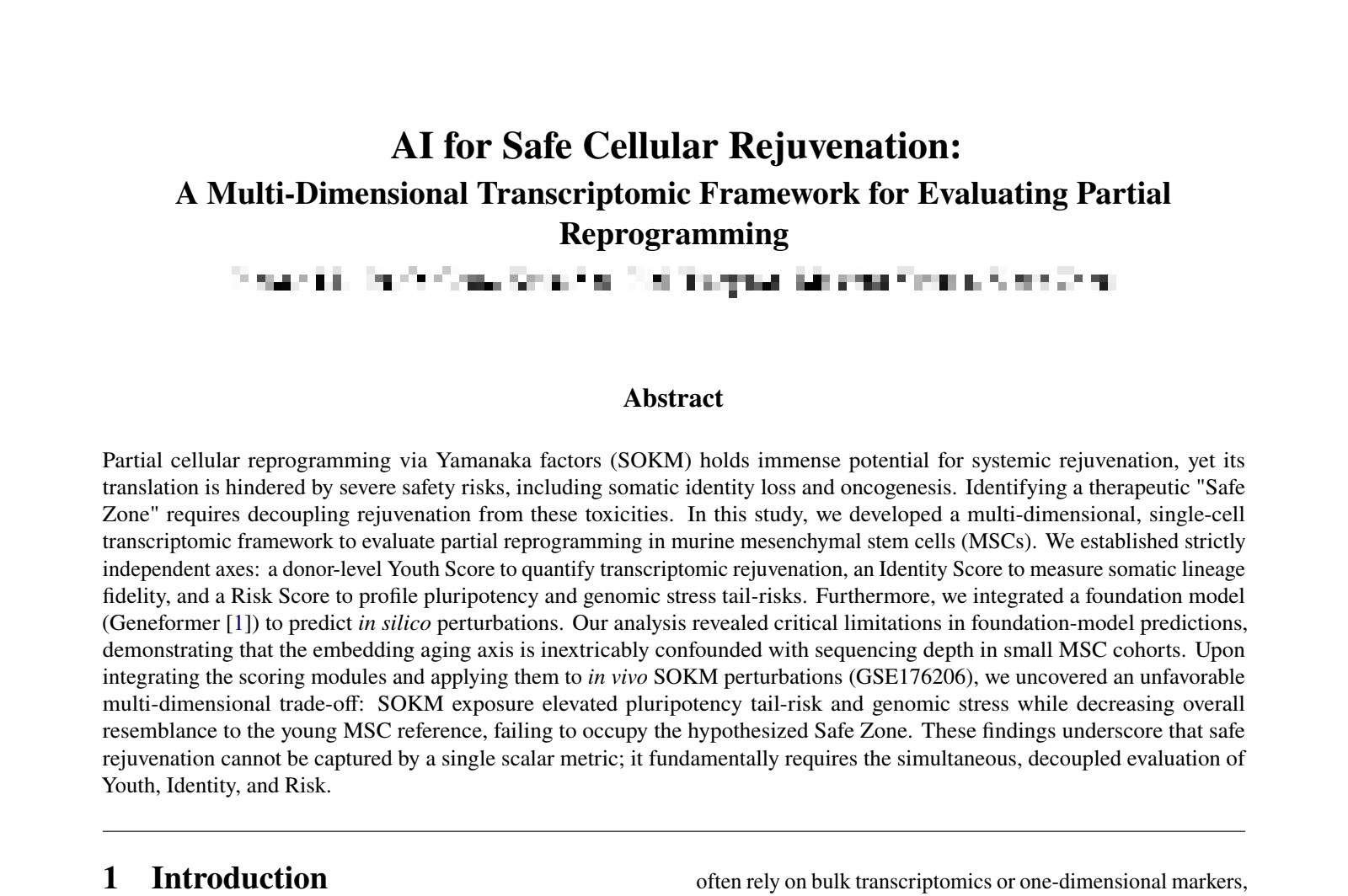
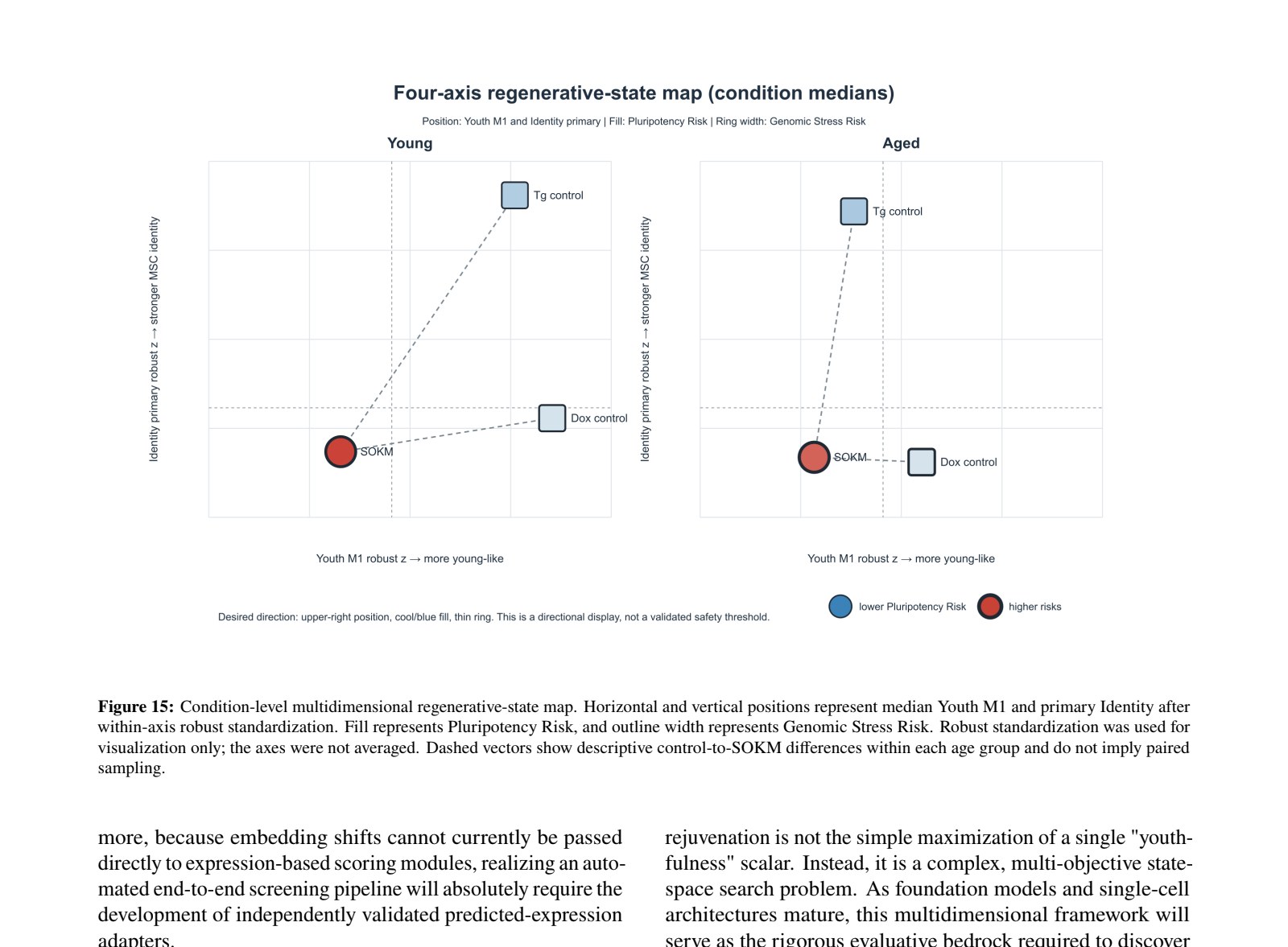
Partial reprogramming with the Yamanaka factors can make aged cells look younger, but it can also erase what makes a cell its type and push it toward a risky, stem-like state. This team built a single-cell framework for mouse mesenchymal stem cells with three independent scores: Youth (resemblance to young cells), Identity (fidelity to the cell type) and Risk (pluripotency and genomic stress). They also tested a foundation model, Geneformer, for predicting the effect of perturbations, and found that its old-to-young axis tracked how many genes were detected per cell. Applied to a published in vivo reprogramming dataset, the tested condition raised both risk scores and lowered youth relative to the young reference in all four comparisons. The team concludes that safe rejuvenation cannot be judged by one number. The analysis is exploratory and transcriptional only.
Keywords · single-cell RNA-seq · partial reprogramming · aging · foundation models · Geneformer · donor-level validation
Who did this work
- Concentration focus
- AI + Health Tech
- Concentration focus
- AI + Health Tech
- Concentration focus
- AI + Health Tech
- Concentration focus
- AI + Health Tech · AI + Business & Finance
- Concentration focus
- AI + Physical Intelligence · AI + Health Tech
- Concentration focus
- AI + Health Tech
Students are not named. Year of study is as of fall 2026. Direction and goal come from each student's own program plan.
1Younger is not the same as safe
Briefly switching on four genes, the Yamanaka factors, can reverse some age-related changes in cells without fully turning them into stem cells [2]. The same process can also weaken the program that makes a cell its type and, pushed too far, raise the risk of tumors.
Many evaluations reduce this to a single "age" number. The team's premise was that a useful evaluation has to measure rejuvenation, identity and risk separately, and look for a condition that improves the first without hurting the other two.
2Three scores, built and checked one animal at a time
- Cleaned the reference data. 815 limb-muscle stem cells from 14 mice in the Tabula Muris Senis atlas [3], after removing 120 cells from a different tissue that appeared only in old animals.
- Built a Youth score. Trained on donor-level data with leave-animal-out validation, so no animal was both trained on and tested.
- Built Identity and Risk scores. Identity measures fidelity to the stem-cell type. Risk has two parts, pluripotency and genomic stress, with a tail-risk measure for rare extreme cells.
- Tested a foundation model. Ran Geneformer [1] zero-shot to see whether its embeddings capture aging and can predict the effect of perturbations.
- Applied everything to a real experiment. Scored a published in vivo reprogramming dataset [4] and compared treated and control animals within young and aged groups.
3The foundation model's aging signal was mostly sequencing depth, and the treatment missed the safe zone
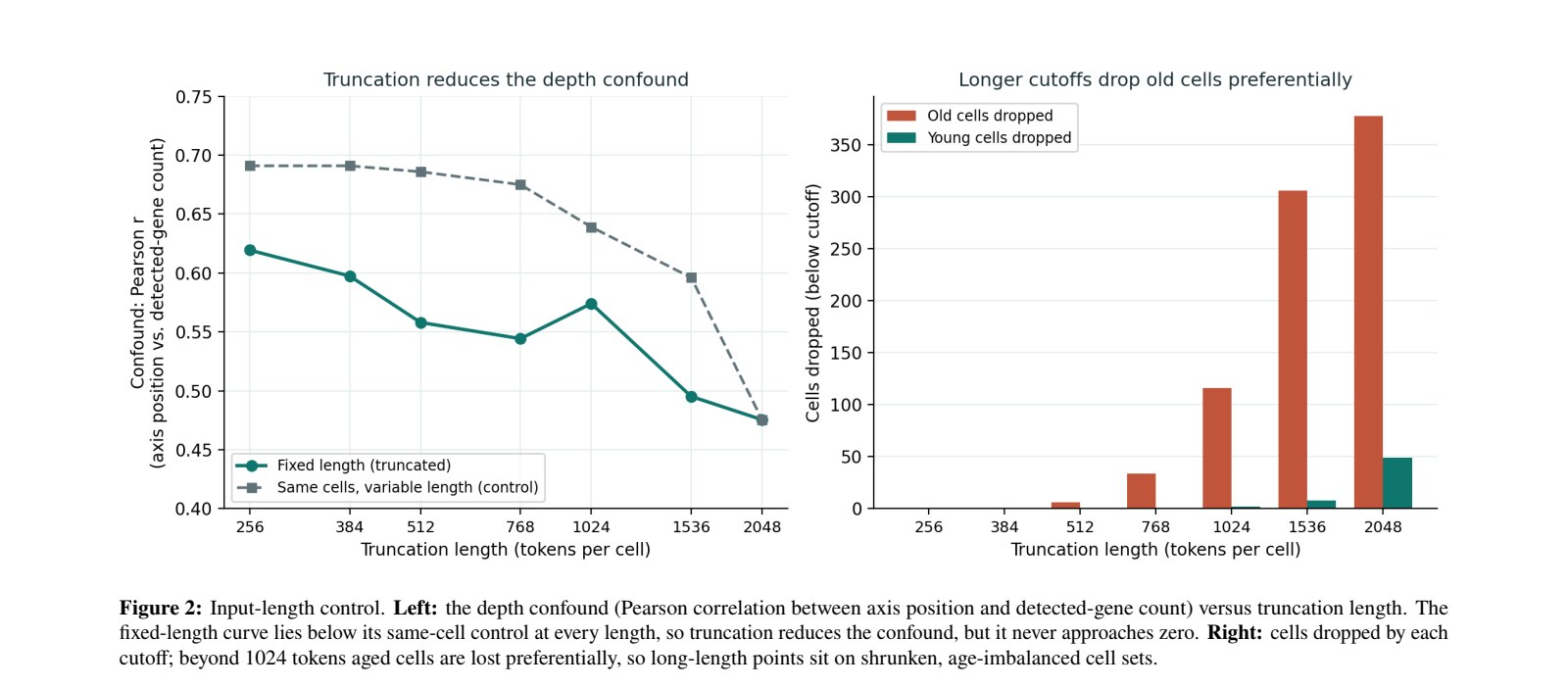
Each cell's position on the model's old-to-young axis correlated with its detected-gene count at r = 0.69. Once that was removed, accuracy fell to 8 of 14 animals and was no longer significant. Old cells also detect fewer genes, so in this cohort age and data depth cannot be separated. The team reported this rather than use the axis to rank perturbations.
| Safe-zone criterion | Comparisons that met it |
|---|---|
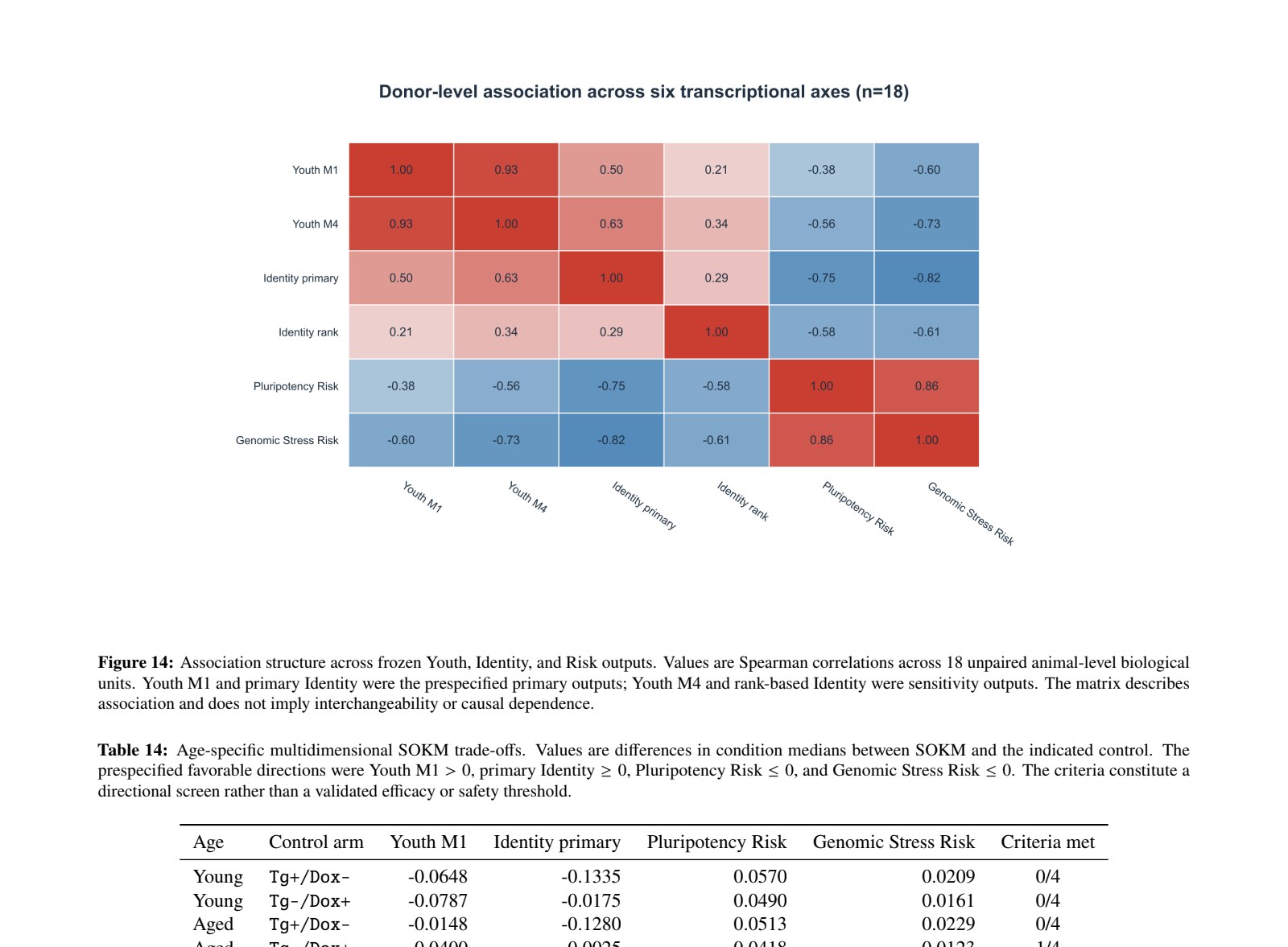
| Youth higher than control | 0 of 4 |
| Identity not lower than control | 1 of 4 |
| Pluripotency risk not higher | 0 of 4 |
| Genomic stress risk not higher | 0 of 4 |
| All four criteria at once | 0 of 4 |
4Pages from the paper
Pages and figures from the team's final paper. Student names are blurred.
5What this does not show
- It does not show that cell reprogramming is unsafe. It shows that the one condition tested did not meet the team's favorable pattern.
- All results are transcriptional. Nothing here measures tissue function or tumor formation.
- The cohorts are small (14 animals for training, 18 animal-level units in the test), so the statistics are exploratory.
- The work uses mouse data and a foundation model pretrained on human cells, with genes mapped across species.
6What this work shows the team can do
Researcher in Computational Biology and Bioengineering
Postdoctoral bioengineering researcher at Stanford. Studies regeneration and stem cell fate. Co-invented the 20-cent Paperfuge. MIT chemistry undergraduate.
The team built the scores, ran the analyses and wrote the paper. The Project Lead met with the team weekly and guided the research questions.
Computational biology · Bioinformatics · Biomedical engineering
A paper that tests a hard question and reports a negative result shows research judgment, not just technique.
7What the Project Lead observed
After the project, the Project Lead wrote an evaluation of each student and placed each one on a four-level scale. This section shows the highest level reached on the team. The notes below describe the team's project. Individual ratings are not published.
System-Level Insight
- 1Foundational Application
- 2Applied Reasoning
- 3Independent Problem Solving
- 4System-Level Insight
Level 4 of 4: anticipates broader implications, risks or downstream effects, and connects technical decisions to real-world impact.
- Framing the problem
- Treated cells as measurements and animals as the unit of biological inference, because averaging cell scores and scoring averaged profiles answer different questions. Defined one shared identifier so every module's output could be joined without ambiguity.
- Decisions and trade-offs
- Kept Youth, Identity and Risk as separate named outputs instead of averaging them. Recorded comparisons as unpaired unless a sample map supported pairing, and left missing values missing rather than imputing them.
- Evidence and testing
- Checked each module against its own written contract (input, preprocessing, scoring unit, aggregation rule, model version and quality-control fields) instead of judging by whether the final numbers looked reasonable.
- Limits and risk
- Declined to feed the foundation model's output into the expression-based scores, since it is an embedding shift, not predicted expression. Kept low-support animals out of the primary analysis.
Source: the Project Lead's written evaluations, July 2026.
References
- Theodoris, C. V. et al. (2023). Transfer learning enables predictions in network biology. Nature, 618, 616–624.
- Roux, A. E. et al. (2022). Diverse partial reprogramming strategies restore youthful gene expression and transiently suppress cell identity. Cell Systems, 13(7), 574–587.
- Tabula Muris Consortium (2020). A single-cell transcriptomic atlas characterizes ageing tissues in the mouse. Nature, 583, 590–595.
- NCBI Gene Expression Omnibus. GSE176206 (2022).
Join the AI for Life Sciences Innovation – Genentech Project
This outcome came out of this project. Work with a computational biologist on a real research question, and leave with a paper you can show.