Shiny surfaces break 3D reconstruction. Fix the photos first, but only where the glare is real.
A team of three students built a preprocessing step that suppresses glare in photos before they go into 3D Gaussian Splatting. It corrects only where reflection evidence holds across several views. Across 561 images, fine detail in protected regions kept a 0.995–0.999 correlation, and in end-to-end 3D tests strong glare responses fell in all four scenes.
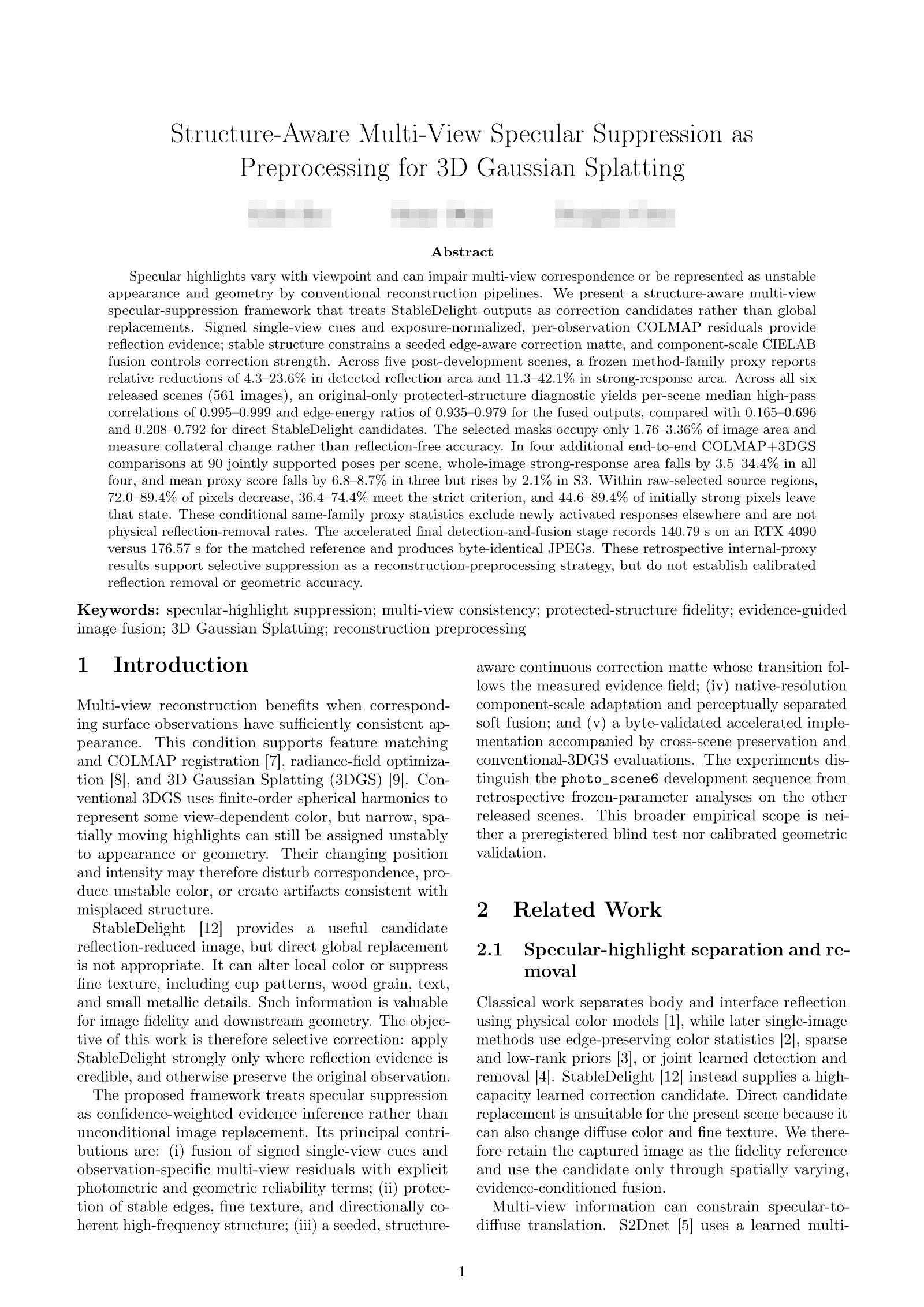
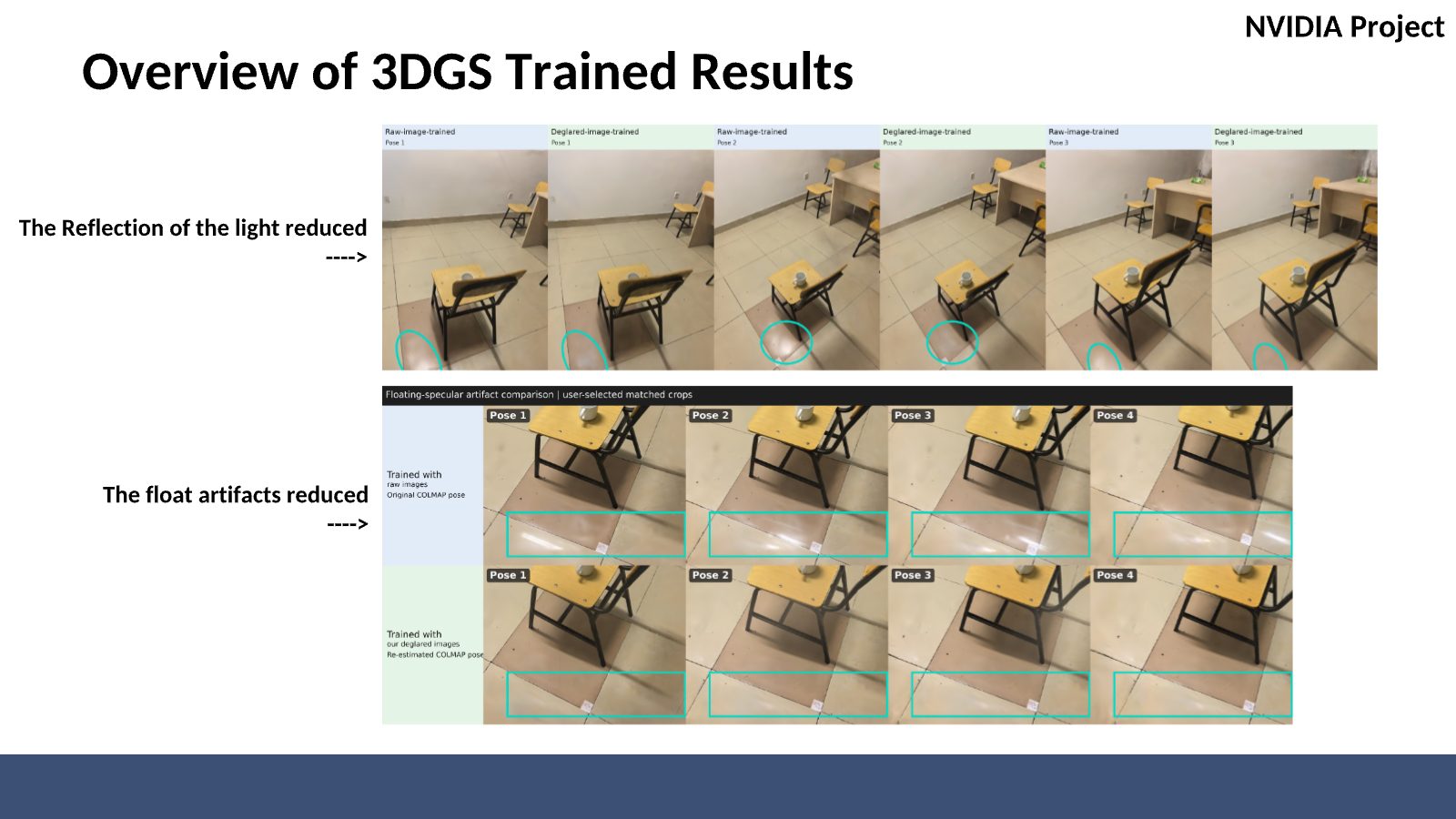
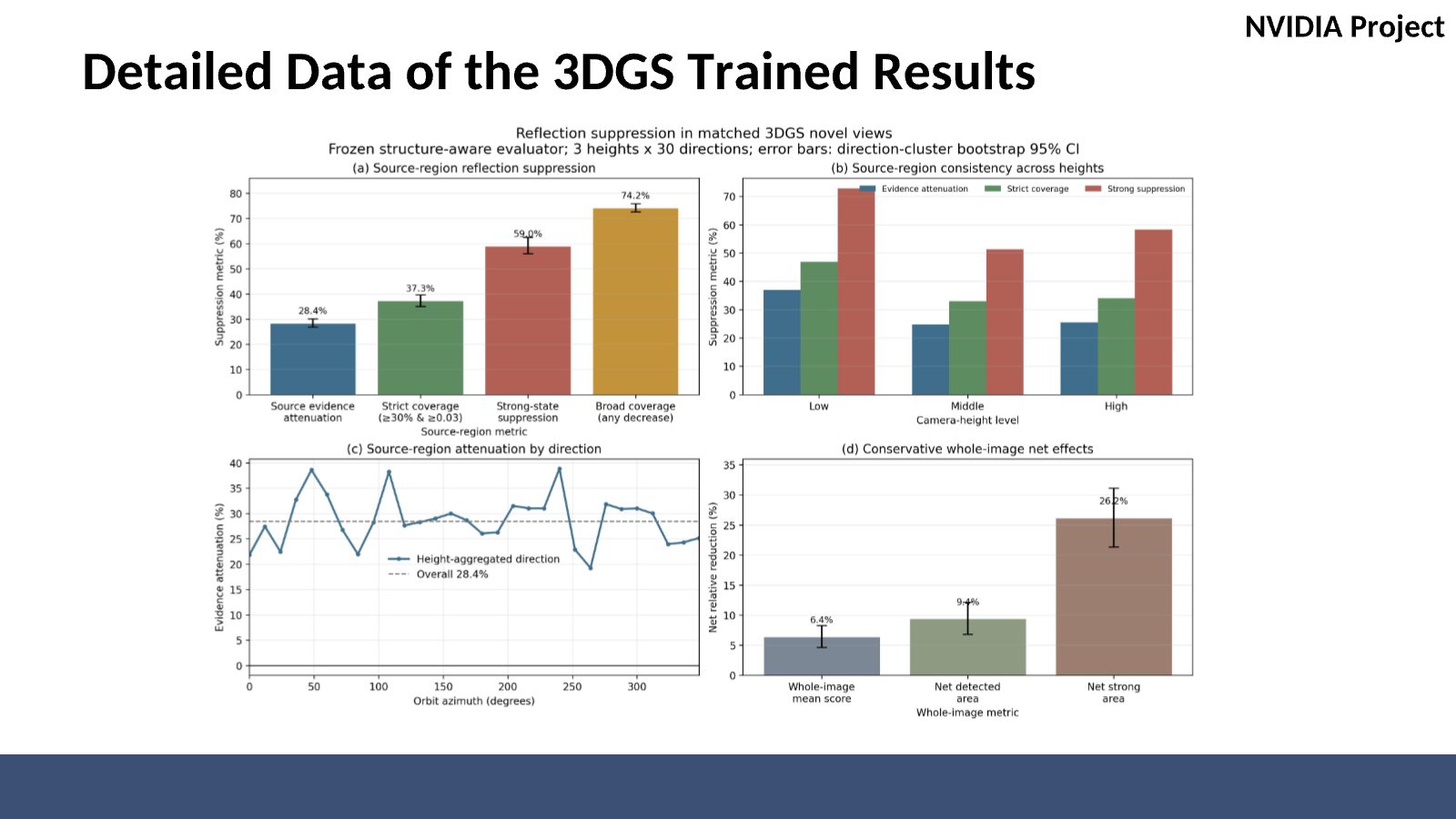
Specular highlights change with viewpoint, so 3D reconstruction treats them as unstable color or geometry. Off-the-shelf deglare models can remove them, but they also smear texture everywhere else. This team treated a 2D deglare model's output as a set of candidate corrections, not a replacement image. They accepted a correction only where single-view cues and multi-view COLMAP residuals both pointed to reflection, constrained it with an edge-aware matte, and blended it in CIELAB color space. Across six scenes (561 images), fine detail in protected regions kept a high-pass correlation of 0.995–0.999, against 0.165–0.696 for the deglare model used directly. In four end-to-end COLMAP + 3D Gaussian Splatting comparisons, strong-response area fell 3.5–34.4% in every scene; the mean proxy score fell in three scenes and rose 2.1% in one. These are internal proxy measures, not calibrated reflection-removal rates.
Keywords · 3D Gaussian Splatting · specular highlights · multi-view consistency · image preprocessing · COLMAP · evidence-guided correction
Who did this work
- Concentration focus
- AI + Physical Intelligence
- Concentration focus
- AI + Health Tech
- Concentration focus
- AI + Vision & Language
Students are not named. Year of study is as of fall 2026. Direction and goal come from each student's own program plan.
1Why glare breaks 3D reconstruction
Methods like 3D Gaussian Splatting build a 3D scene from many ordinary photos. They assume a point on a surface looks the same from every angle. Glare breaks that rule: a highlight moves as the camera moves, so the reconstruction either bakes it in as a wrong color or invents floating geometry to explain it.
Deglare models trained on single photos can remove highlights, but applied to every pixel they also wash out texture that the reconstruction needs. The team asked whether they could keep the benefit and avoid the damage by correcting only where several views agreed the highlight was a reflection.
2Treat the deglare output as a suggestion
- Proposed corrections. Ran StableDelight, a pretrained 2D deglare model, on every photo and treated its output as a candidate, not a final image.
- Collected evidence. Combined signed single-view cues with exposure-normalized COLMAP residuals, which show where a pixel disagrees with the same surface seen from other views.
- Protected structure. Built an edge-aware correction matte seeded from that evidence, so edges and texture outside the reflection stay untouched.
- Blended with control. Fused the correction in CIELAB color space at component scale, so the strength of the change follows the evidence.
- Tested in 2D and 3D. Measured collateral change on 561 images, then ran four full COLMAP + 3D Gaussian Splatting comparisons at 90 matched camera poses per scene.
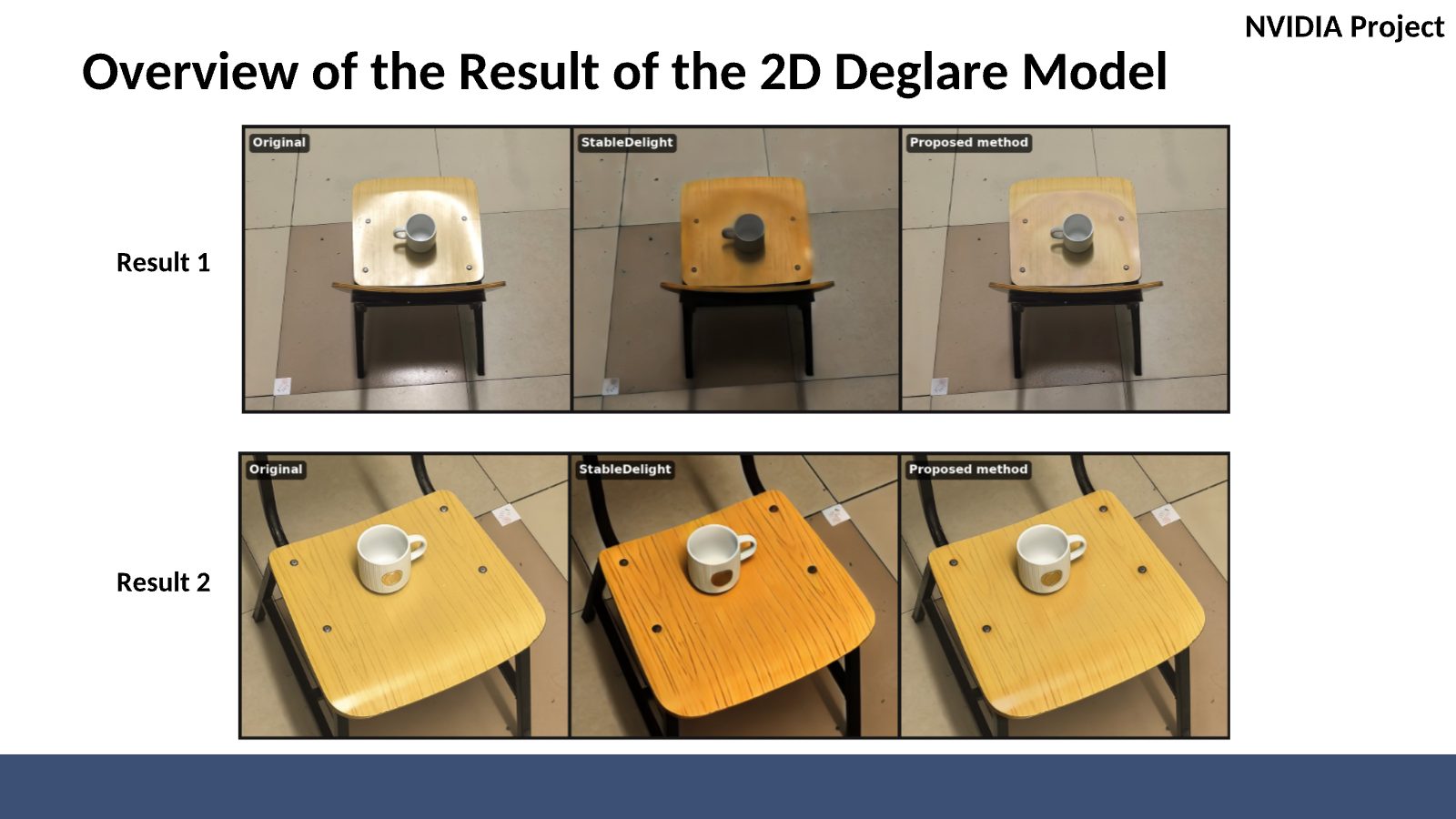
3Texture kept, glare reduced, one scene that went the other way
| Measure | Team's method | Deglare model alone |
|---|---|---|
| High-pass correlation in protected regions (6 scenes) | 0.995–0.999 | 0.165–0.696 |
| Edge-energy ratio in protected regions | 0.935–0.979 | 0.208–0.792 |
| End-to-end 3D test (4 scenes) | Result |
|---|---|
| Strong-response glare area | Fell 3.5–34.4% in all four scenes |
| Mean proxy score | Fell 6.8–8.7% in three scenes, rose 2.1% in one |
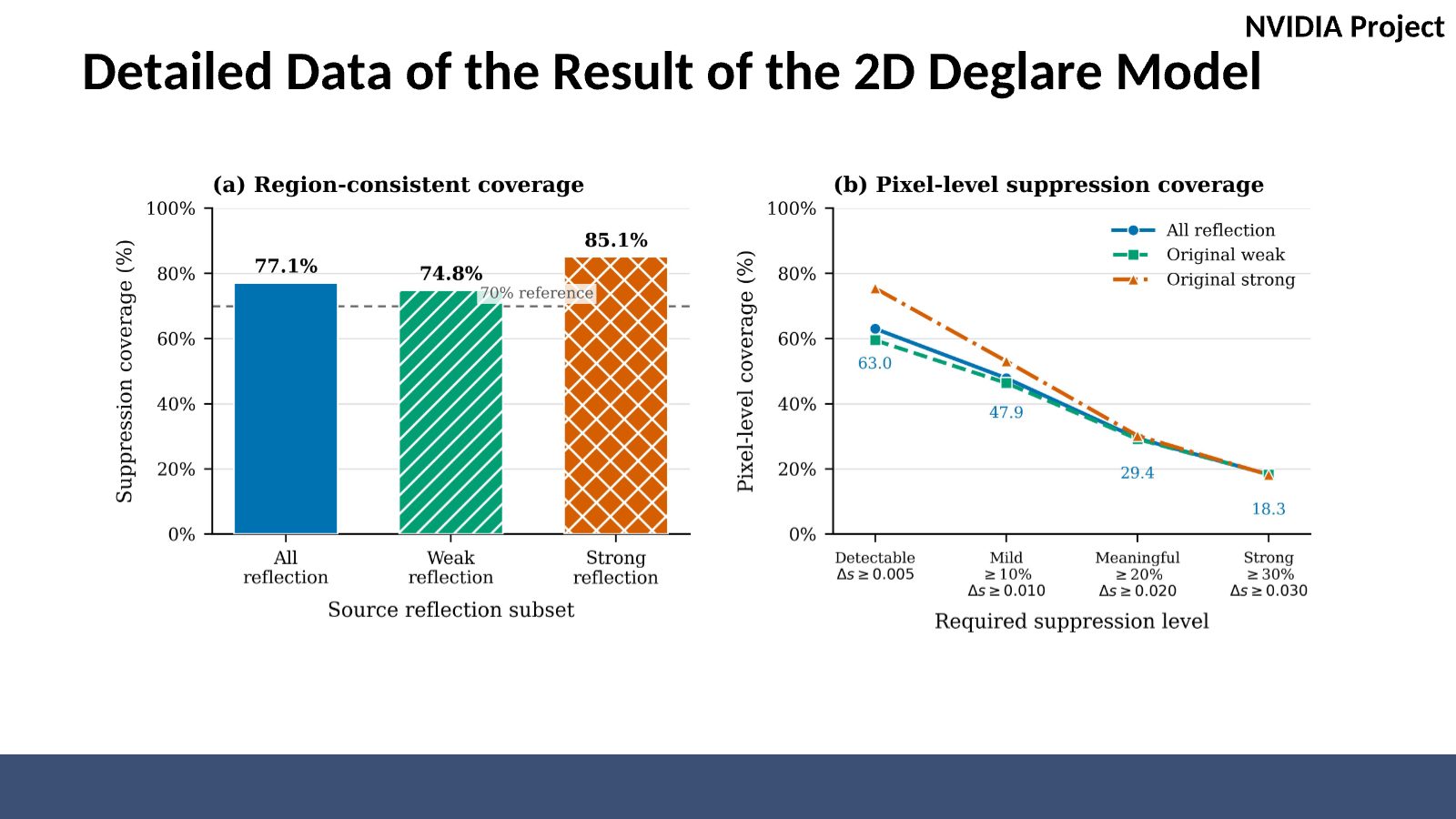
| Pixels in the original glare regions where the glare score dropped | 72.0–89.4% |
| Final detection and fusion time (RTX 4090) | 140.79 s vs. 176.57 s for the reference |
4The paper and selected slides
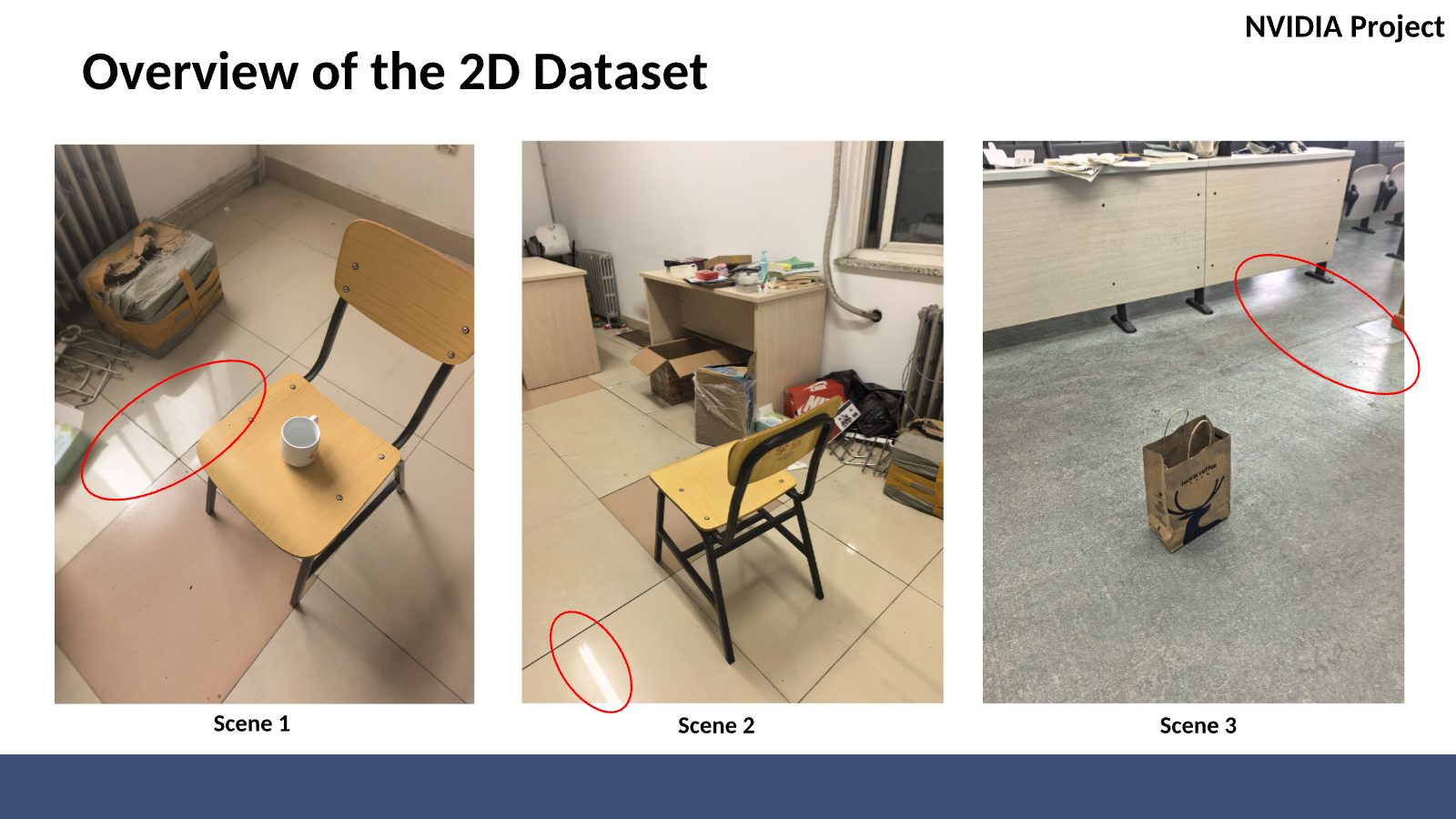
Pages from the team's final paper and presentation. Student names are blurred.
5What this does not show
- The glare measures are internal proxies from the same family of methods, not calibrated reflection-removal rates.
- The study does not establish geometric accuracy of the final 3D scenes.
- Results cover six scenes the team selected; other surfaces and lighting may behave differently.
- The analysis was retrospective, run on scenes after the method was developed.
6What this work shows the team can do
Researcher in Computer Graphics and Deep Learning
Researcher at MIT CSAIL, Computational Design and Fabrication Group. Published at SIGGRAPH, CVPR and ACM Transactions on Graphics. Interned at NVIDIA, Meta Reality Labs and Google.
The team built the method, ran the experiments and wrote the paper. The Project Lead guided the research direction and reviewed the work.
Computer vision · Computer graphics · 3D reconstruction
A full research paper with code and a stated measurement boundary works well as a writing sample.
7What the Project Lead observed
After the project, the Project Lead wrote an evaluation of each student and placed each one on a four-level scale. This section shows the highest level reached on the team. The notes below describe the team's project. Individual ratings are not published.
Independent Problem Solving
- 1Foundational Application
- 2Applied Reasoning
- 3Independent Problem Solving
- 4System-Level Insight
Level 3 of 4: evaluates alternatives, adapts the approach based on evidence or constraints, and works with meaningful independence.
- Framing the problem
- Framed the work operationally: which datasets, which methods, and which experiments would test glare suppression for 3D Gaussian Splatting. Kept the goal on measurable reconstruction impact, not just nicer 2D photos.
- Decisions and trade-offs
- Made practical trade-offs in the experiment setup to stay within compute and time limits, and balanced effort across implementation, dataset preparation and reporting.
- Evidence and testing
- Compared original and processed inputs in the reconstruction pipeline, gathered real reflective scenes, and checked whether the method behaved as intended across cases.
- Limits and risk
- Recognized that results depend on the dataset and reflection type, that imperfect 2D outputs can carry into 3D, and that global metrics can understate local improvement.
Source: the Project Lead's written evaluations, August 2026.
References
- Kerbl, B. et al. (2023). 3D Gaussian Splatting for real-time radiance field rendering. ACM Transactions on Graphics, 42(4).
- Schönberger, J. L. & Frahm, J.-M. (2016). Structure-from-motion revisited. CVPR.
- StableDelight: a pretrained model for removing specular reflections from single images (open-source release).
Join the Computer 3D Graphics and Deep Learning – NVIDIA Project
This outcome came out of this project. Work with a graphics researcher on an open problem in 3D reconstruction, and leave with research you can show.