Why do big banks struggle to scale their own innovation?
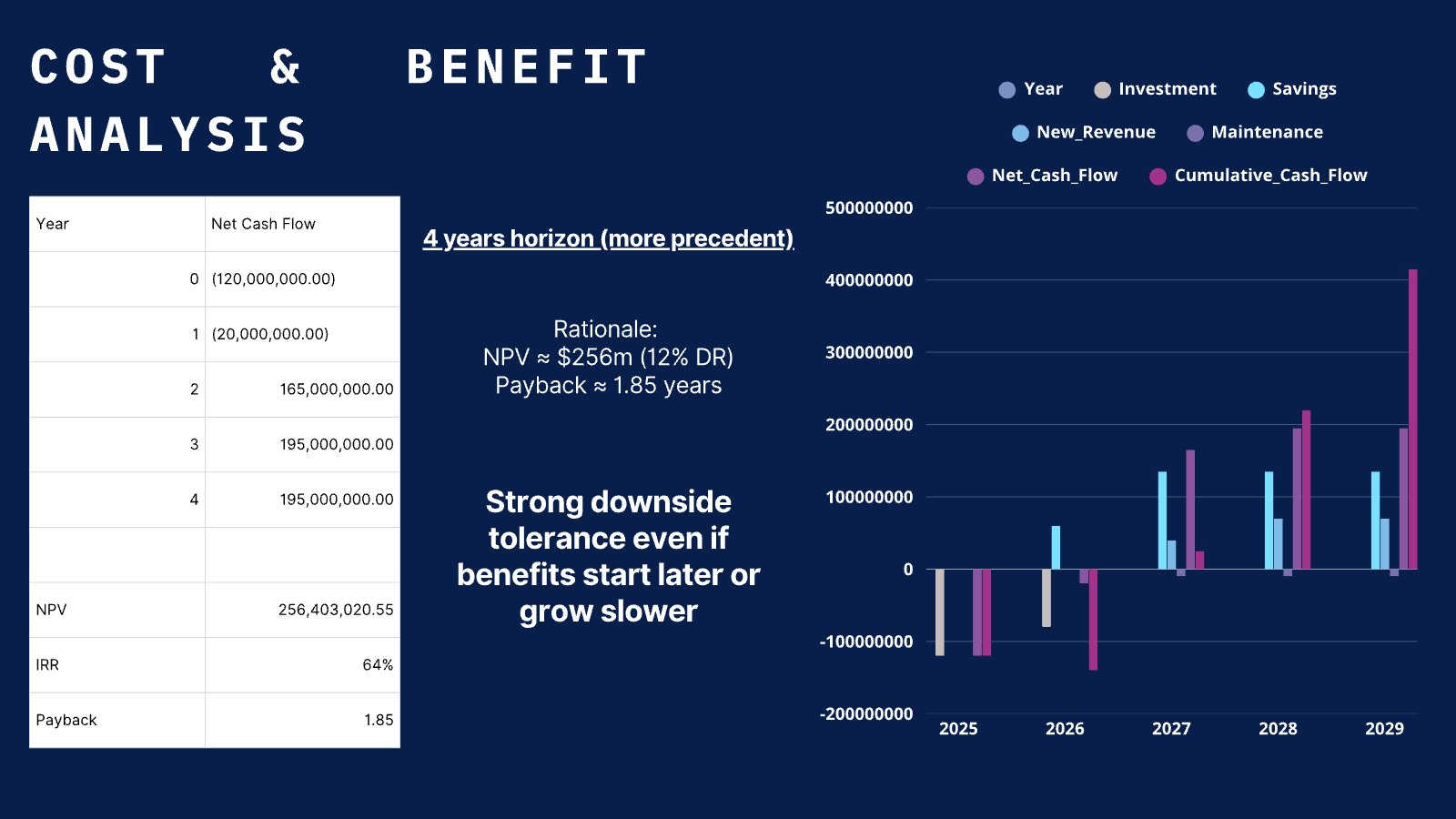
Jun Ting Lip and two teammates used JPMorgan as a case study. They traced slow innovation to structure (fragmented teams, long approvals, duplicated tech work), benchmarked DBS, Goldman Sachs and Microsoft, and proposed a Startup Factory plus a shared platform layer. Their financial model, built on their own assumptions, put the 4-year NPV at about $256M at a 12% discount rate, with payback in about 1.85 years on a $200M investment.
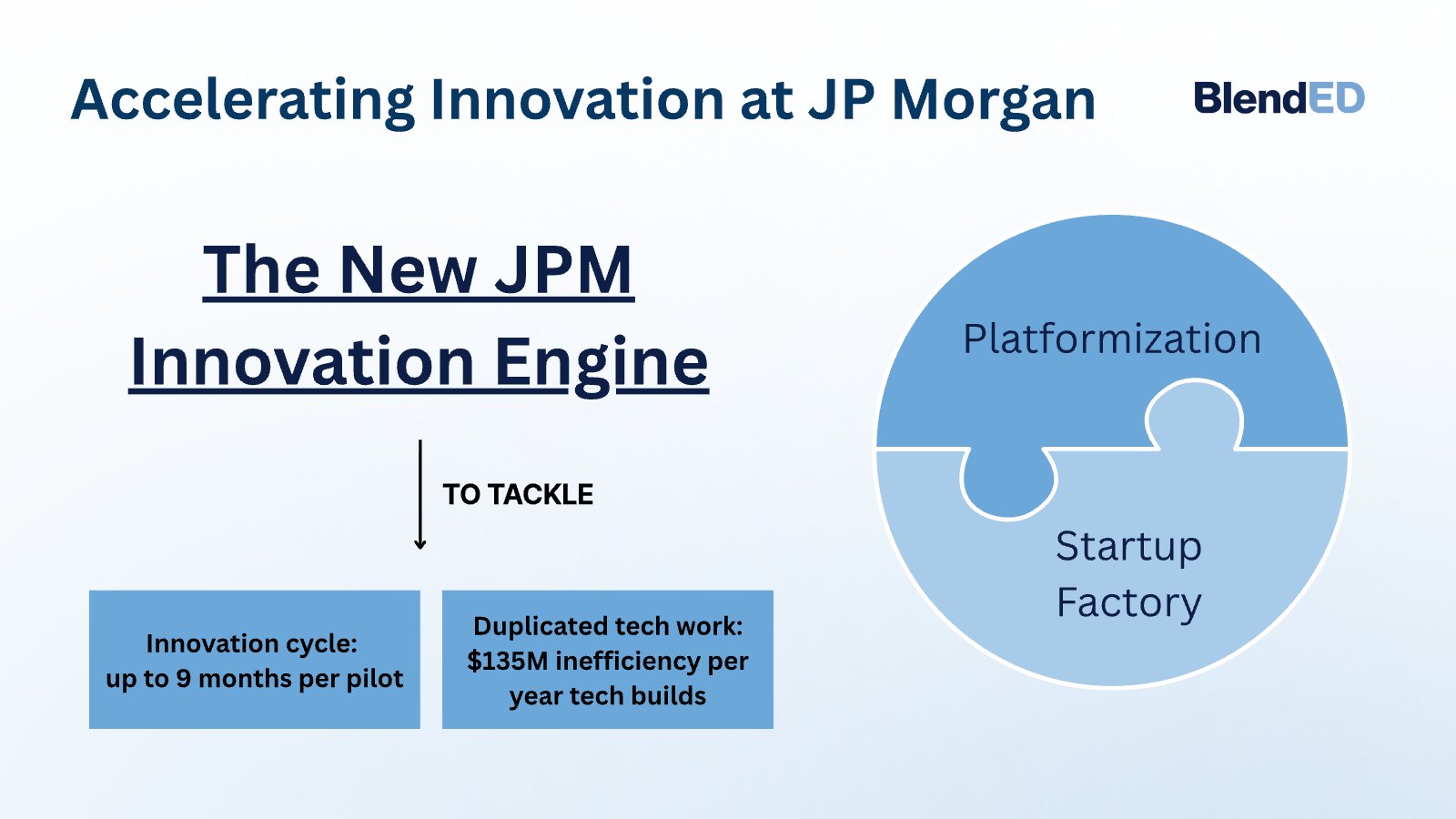
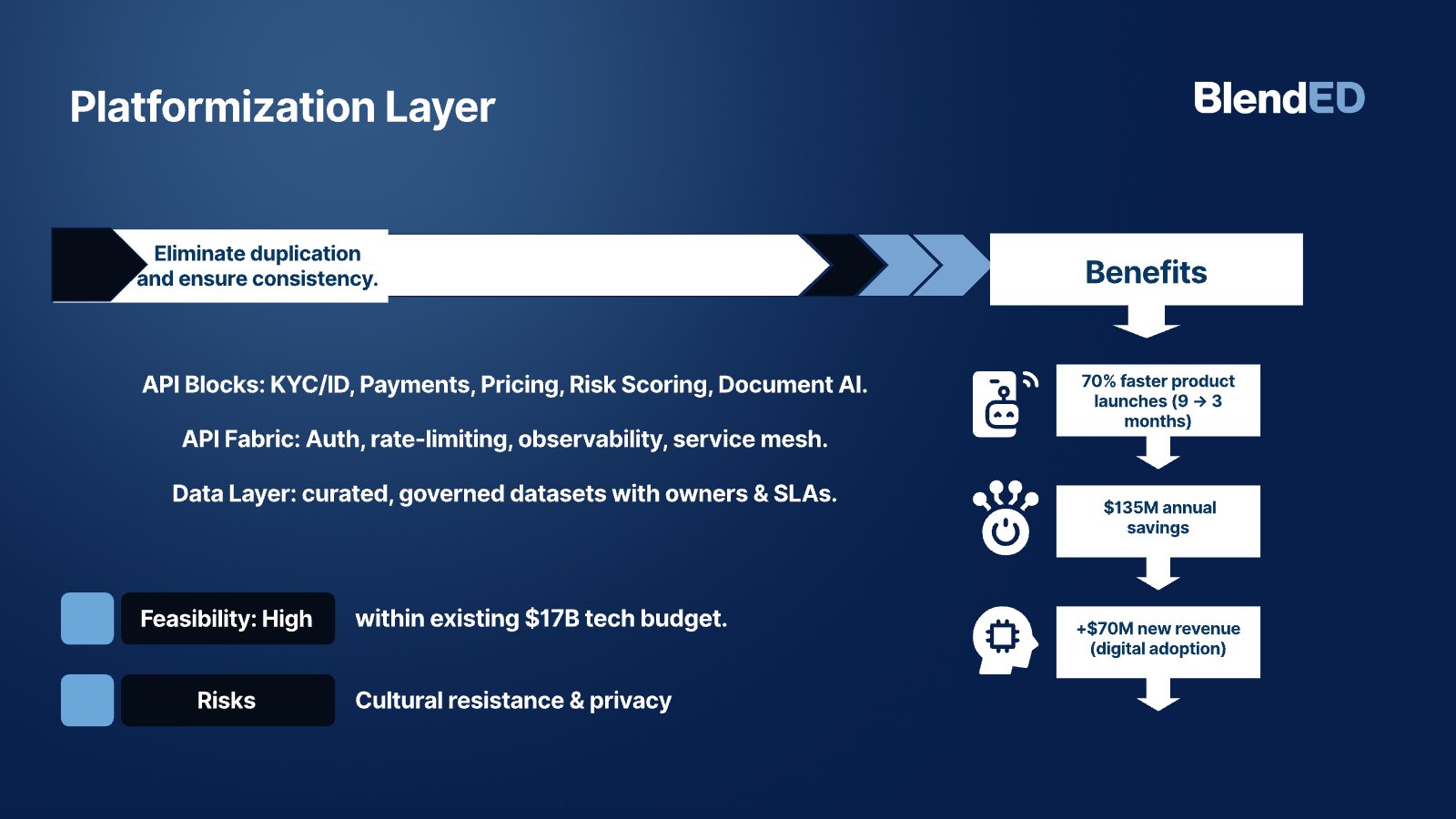
Large banks spend heavily on technology, yet many internal innovation projects stay isolated and never scale. Using JPMorgan as a case study, this team diagnosed the causes as structural: centralized ownership without clear KPIs, regulatory approval across many markets, divisions rebuilding the same technology, and incentives tied to traditional performance. They benchmarked DBS, Goldman Sachs and Microsoft and proposed an "Innovation Loop": a Startup Factory of small cross-functional teams for fast, compliant pilots, and a Platformization layer of reusable APIs and governed data so successful pilots scale across divisions. Their cost–benefit model assumed a $200M investment over two years, savings from removing duplicated work, and new digital revenue. Over four years at a 12% discount rate it gave an NPV of about $256M and payback in about 1.85 years. They rejected a version with a terminal value (NPV about $1.52B) because the terminal value inflated the result, and recommended stage-gated funding with benefits tracked by Finance.
Keywords · corporate strategy · innovation management · banking · platform strategy · NPV · stage-gate governance
Who did this work

- On this project
- Built the financial model and the governance design.
Students named here agreed to be featured. 2 other team members are not named. Role notes come from the Project Lead's feedback.
1Big budgets, slow scaling
Large banks have the money and talent to innovate, but internal projects often stay isolated, and new capabilities are frequently bought through partnerships or acquisitions instead.
The team asked what in the organization slows ideas down, and what structure would let a regulated bank move closer to fintech speed without losing control.
2A consulting-style approach
- Diagnosed. Mapped structural barriers: centralized ownership without clear KPIs, regulatory oversight across many markets, siloed divisions and traditional incentives.
- Benchmarked. Studied how DBS, Goldman Sachs and Microsoft scaled internal innovation.
- Designed. Proposed a Startup Factory for fast, compliant pilots and a Platformization layer of reusable APIs and governed data.
- Modeled. Built a cost–benefit model with explicit assumptions, compared horizons, and set stage gates for a board decision.
3The model and the recommendation
| Assumption or output | Value in the team's model |
|---|---|
| Investment | $200M over two years ($120M, then $80M) |
| Savings from removing duplicated work | $60M in year 1, then $135M a year |
| New digital revenue | $40M in year 2, then $70M a year |
| Platform upkeep | $10M a year from year 2 |
| NPV, 4 years at 12% | ≈ $256M (IRR 64%) |
| NPV with a terminal value | ≈ $1.52B (rejected as inflated) |
| Payback | ≈ 1.85 years |
4Selected slides
Slides from the team's final presentation.
5What this does not show
- The analysis is outside-in; assumptions were not validated with JPMorgan.
- Savings and revenue figures are the team's estimates.
- The downside case is argued, not modeled in detail.
- This is a student case study, not a JPMorgan engagement.
6What this work shows
Faculty in Corporate Strategy
Assistant Professor in corporate and global strategy. PhD in Strategy, UCLA.
The team did the analysis and the model. The Project Lead guided the work and reviewed it.
Strategy consulting · Finance · Innovation management
A recommendation with explicit assumptions and a rejected optimistic case shows sound judgment.
7What the Project Lead observed
The Project Lead wrote feedback on the project at the end of the program.
Written feedback only
This cohort ran before the four-level capability rating was recorded, so this page shows the Project Lead's written feedback without a level.
- Analytical approach
- A strong, sophisticated analytical approach to a complex transformation question.
- Contribution
- Jun Ting's financial modeling and governance design showed a high level of strategic reasoning, with clear justification for each assumption and scenario.
- Structure
- A structured analysis of innovation barriers and organizational design choices.
- Work habits
- The Academic Coordinator noted her discipline, careful validation of results and consistently high-quality analytical work.
Source: the Project Lead's and Academic Team's written feedback, 2025.
References
- Team's final presentation (2025): Project NEXUS – connecting innovation efforts across JPMorgan.
Join the Machine Learning in Quantitative Finance – J.P. Morgan Project
Work with a strategy researcher on a real business problem and leave with analysis you can defend.